




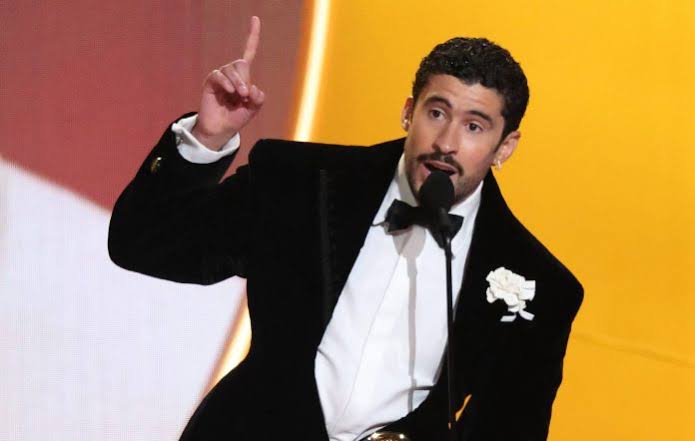

When Bad Bunny’s name was announced as the winner of Album of the Year at the 68th Grammy Awards on February 1, 2026, the Puerto Rican superstar didn’t celebrate immediately. Instead, he bowed his head, covered his face, and wept for several seconds before slowly making his way to the stage. His album “DeBÍ TiRAR MáS FOToS” (which translates to “I Should Have Taken More Photos”) had just accomplished what no Spanish-language album had achieved in the 66-year history of the Grammy’s top prize: winning Album of the Year.
The moment represents more than one artist’s triumph. It’s a seismic shift in how the Recording Academy—and by extension, the American music industry—views music performed in languages other than English. For decades, Spanish-language artists have been relegated to Latin-specific categories, no matter how commercially successful or critically acclaimed their work. Bad Bunny’s win shatters that glass ceiling and opens doors for artists worldwide who create music in their native languages.
The Historic Moment: “For Puerto Rico, For Latin America”
As Bad Bunny took the stage, tears still streaming down his face, he delivered an emotional acceptance speech that acknowledged the weight of what had just happened:
“This is for Puerto Rico, for Latin America, for everyone who believed in me,” he said, his voice breaking with emotion. “This album is about family, about loss, about appreciating the moments we have before they’re just memories. Thank you for understanding that music doesn’t need to be in English to be universal.”

The camera captured fellow nominees giving him a standing ovation—Kendrick Lamar, Tyler, The Creator, and even Justin Bieber were on their feet applauding. The moment transcended competition; everyone in the room understood they were witnessing history.



Before accepting the award, Bad Bunny also used his platform for political activism, opening his Best Música Urbana Album speech earlier in the night with a powerful statement:
“Before I say thanks to God, I’m going to say, ‘ICE out.’ We’re not savage. We’re not animals. We’re not aliens. We are humans, and we are Americans. I know it’s tough not to hate these days. The hate gets more powerful with more hate. The only thing that’s more powerful than hate is love. If we fight, we have to do it with love. We love our people, and we love our family. And that’s the way to do it—with love.”
His political statement, delivered in both English and Spanish, addressed the Trump administration’s immigration enforcement actions that had sparked protests throughout the Grammy ceremony, with numerous artists wearing “ICE Out” pins.
The Album: “DeBÍ TiRAR MáS FOToS” (I Should Have Taken More Photos)
About the Title and Concept
The album’s title comes from a deeply personal place of regret and reflection. Bad Bunny has explained that it refers to the universal feeling of wishing you had captured more moments with loved ones—especially those who are no longer with us or situations that have passed.
The title is deliberately written in Bad Bunny’s signature style: mixing uppercase and lowercase letters randomly, a aesthetic choice that has become part of his brand identity. This stylistic flourish appears throughout all his album titles and social media presence.
Musical Style and Themes
“DeBÍ TiRAR MáS FOToS” is a departure from Bad Bunny’s earlier, more party-oriented work. While maintaining his signature reggaeton and Latin trap foundations, the album incorporates:
– Salsa influences – Honoring traditional Puerto Rican music
– Bolero elements – Romantic ballad styles from Latin America
– Acoustic arrangements – Stripped-down production highlighting vulnerability
– Experimental production – Pushing boundaries of reggaeton
Major themes explored:
– Family relationships and mortality
– Nostalgia for childhood and simpler times
– The passage of time and impermanence
– Puerto Rican identity and pride
– Loss and grief
– Appreciating the present moment
The album is notably more introspective and emotional than his previous work, with Bad Bunny singing about his grandmother, his mother, and the fleeting nature of life with raw vulnerability rarely heard in mainstream reggaeton.
Critical and Commercial Success
Critical Reception:
– Near-universal acclaim from music critics
– Praised for emotional depth and artistic maturity
– Recognized for sophisticated production
– Celebrated for maintaining commercial appeal while being experimental
Commercial Performance:
– Multi-platinum certifications
– Billions of streams across platforms
– Topped charts in multiple countries
– One of the year’s best-selling albums globally



The album proved that Spanish-language music could achieve both critical prestige and massive commercial success without compromising artistic integrity or linguistic authenticity.
Breaking Down the Barrier: Why This Win Matters
66 Years of English-Language Dominance
Since the Grammy Awards began in 1959, Album of the Year has been awarded 66 times before Bad Bunny’s win. Every single winner was performed predominantly or entirely in English. This wasn’t for lack of worthy Spanish-language albums; it reflected systemic bias within the Recording Academy’s voting membership.
Previous Spanish-language nominees for Album of the Year:
– None in the first 50 years (1959-2009)
– Shakira’s albums were sung in English when she received nominations
– Latin artists who achieved mainstream success typically recorded English-language albums to compete in top categories
Bad Bunny’s win is even more remarkable because he never compromised. He didn’t record an English version. He didn’t add English-speaking features to increase crossover appeal. He made an entirely Spanish-language album about deeply Puerto Rican experiences—and the Recording Academy voted it the best album of the year.
The Latin Music Ghetto
For decades, the Grammy Awards maintained a separate “Latin” category ecosystem where Spanish-language artists could win awards without ever competing in the “main” categories. This segregation implied that Spanish-language music was somehow “different” from “real” music, which was assumed to be in English.
The problem with Latin-specific categories:
– Segregated Spanish-language artists regardless of commercial success
– Implied Spanish-language music couldn’t compete with English-language music
– Limited visibility for Latin artists to mainstream American audiences
– Reinforced linguistic and cultural hierarchies
Bad Bunny’s Album of the Year win doesn’t erase these separate Latin categories—they still exist and serve an important purpose. But his victory proves that Spanish-language albums can and should compete in all categories based on quality, not language.
The Commercial Reality: Bad Bunny’s Numbers
Bad Bunny’s win wasn’t a “charity” recognition or “diversity” gesture. The numbers prove he was commercially dominant:
Before the Grammy win, Bad Bunny was:
– The most-streamed artist on Spotify globally (2020, 2021, 2022)
– One of the highest-grossing touring acts in the world
– Selling out stadiums across North America, Latin America, and Europe
– Achieving billions of streams while singing exclusively in Spanish
His success demonstrated that language barriers in music are artificial constructs maintained by industry gatekeepers, not by actual listeners. People around the world—including millions who don’t speak Spanish—connected deeply with his music.
The Reaction: Global Celebration
Latin America Erupts
Throughout Latin America, the reaction was jubilant celebration:
In Puerto Rico: People poured into the streets of San Juan celebrating Bad Bunny’s win as a validation of Puerto Rican culture. Given Puerto Rico’s complicated political status (a U.S. territory without statehood), the win felt especially significant—a Puerto Rican artist conquering the mainland American music industry on his own terms.
In Mexico, Colombia, Argentina, and beyond: Latin American countries celebrated the win as recognition of Spanish-language music’s global influence. Social media exploded with pride and emotion.
U.S. Latino Community
For U.S. Latinos—many of whom grew up being told to speak English and assimilate—Bad Bunny’s win was deeply emotional:
“I’m crying. My parents spoke Spanish at home and I was ashamed as a kid. Bad Bunny just won the biggest music award in America singing only in Spanish. This means everything.”
“Bad Bunny winning Album of the Year is the cultural moment we’ve been waiting for our entire lives.”
The win validated Spanish language and Latino culture in a way that felt overdue to millions of Americans who’ve lived between two cultures.
Music Industry Response
Fellow artists, producers, and industry professionals recognized the historic significance:
Rosalía (Spanish singer): “Bad Bunny opened doors for all of us. This is OUR moment.
*J Balvin (Colombian artist): “History was made tonight. The world listens in all languages.”
Lin-Manuel Miranda (Puerto Rican creator of Hamilton): “From Puerto Rico to the world. @sanbenito is changing the game. So proud.”
Even artists outside Latin music celebrated the win as a victory for linguistic and cultural diversity in music.
The Inevitable Backlash
Not everyone celebrated. Critics of Bad Bunny’s win argued:
“I didn’t understand a word” – Some English-only speakers complained the award should require comprehension
“Diversity selection” – Cynics suggested Bad Bunny won for political correctness rather than merit
“Latin categories exist for a reason” – Some argued Spanish-language albums should stay in Latin-specific categories
These criticisms revealed exactly why Bad Bunny’s win matters: they exposed the assumption that English is the default, “normal” language for music, and everything else is “other.”
The Artist: Who is Bad Bunny?
Benito Antonio Martínez Ocasio
Born March 10, 1994, in Almirante Sur neighborhood of Vega Baja, Puerto Rico, Benito Antonio Martínez Ocasio adopted the stage name “Bad Bunny” from a childhood photo where he was dressed as a bunny and looked unhappy.
Early Life:
– Raised in Puerto Rico by working-class parents
– Father was a truck driver; mother was a teacher
– Grew up listening to reggaeton, salsa, and merengue
– Sang in church choir as a child
Career Breakthrough:
– Started uploading music to SoundCloud while studying at University of Puerto Rico
– Worked as a supermarket bagger while pursuing music
– Breakthrough came when DJ Luian discovered his SoundCloud
– 2017 single “Soy Peor” launched him to fame
Global Superstar Status
By the time “DeBÍ TiRAR MáS FOToS” was released, Bad Bunny had already achieved:
Commercial Dominance:
– Multiple #1 albums in the United States
– Billions of streams (most-streamed artist globally multiple years)
– Sold-out stadium tours worldwide
– Collaborations with Drake, Cardi B, J Balvin
Cultural Impact:
– Fashion icon (gender-fluid style, painted nails)
– Acting roles (including Marvel’s “El Muerto”)
– Wrestled at WWE Royal Rumble
– Advocate for LGBTQ+ rights
– Puerto Rican political activist
Previous Grammy Wins:
– Multiple Latin Grammy Awards
– Grammy for Best Música Urbana Album (2021)
– Grammy for Best Música Urbana Album (2023)
But Album of the Year eluded him—until now.
Why Bad Bunny Matters Beyond Music
Bad Bunny represents more than commercial success:
Cultural Pride: He proudly performs entirely in Spanish, representing Puerto Rico globally without compromise
Gender Norms: He challenges machismo in reggaeton and Latin culture, wearing dresses, painting his nails, and advocating for LGBTQ+ rights
Political Voice: He uses his platform to address Puerto Rican issues, including Hurricane Maria recovery and political corruption
Authenticity: Unlike artists who “go English” for crossover success, he proved you can conquer the world on your own terms
Comparing to Past Latin Artists at the Grammys
The Crossover Compromise
Previous Latin artists who achieved Grammy success in major categories typically compromised linguistically:
Ricky Martin – “Livin’ la Vida Loca” was in English
Shakira – Her Grammy-winning albums were predominantly English
Santana – Instrumental music or English vocals
Gloria Estefan – Primarily recorded in English for mainstream success
These artists are legends and their choices were valid for their time. But Bad Bunny proved the compromise is no longer necessary.
The Latin Grammy vs. Grammy Distinction
The Latin Grammy Awards, established in 2000, celebrate Spanish and Portuguese-language music. While prestigious within Latin music communities, they don’t carry the same mainstream American cultural weight as the “regular” Grammys.
Bad Bunny winning both Latin Grammys AND the major Grammy Album of the Year achieves something unprecedented: recognition in both spheres without compromise.
What This Means for the Future
The Doors This Opens
Bad Bunny’s win will likely lead to:
More Spanish-language nominations in major categories – Recording Academy voters now see it’s possible
Less pressure on Latin artists to record in English – Artistic authenticity is commercially viable
Increased Latino representation in Grammy voting membership – The Academy has been expanding its membership to be more diverse
Global music gaining more recognition – If Spanish can win, why not Korean, French, Arabic, Portuguese?
The BTS Precedent
BTS, the Korean pop supergroup, came close to achieving what Bad Bunny accomplished. They were nominated for major categories while singing primarily in Korean. They didn’t win Album of the Year, but their nominations broke similar ground for non-English music.
Bad Bunny’s win suggests that the Recording Academy is finally catching up to what listeners have known for years: great music transcends language barriers.
The Streaming Revolution’s Role
Streaming platforms like Spotify, Apple Music, and YouTube have democratized music discovery. American listeners are discovering international artists without industry gatekeepers filtering content.
The data proves it:
– Bad Bunny was Spotify’s most-streamed artist globally for three consecutive years
– K-pop artists regularly chart in the U.S. without singing in English
– Latin music has become the fastest-growing genre in the U.S.
The Recording Academy’s recognition of Bad Bunny reflects this new reality: language is no longer a barrier to reaching massive audiences.
The Night’s Full Context: Grammy Political Moment
Bad Bunny’s win occurred during a Grammy ceremony that became a platform for political protest:
ICE Out Movement:
– Multiple artists wore “ICE Out” pins protesting immigration enforcement
– Billie Eilish declared “No one is illegal on stolen land”
– Bad Bunny himself opened his acceptance speech with “ICE out”
Immigration Theme:
– Recent ICE killings in Minneapolis motivated the protests
– Artists of immigrant backgrounds used their platforms
– The ceremony became a referendum on Trump administration policies
Bad Bunny’s win and his political statement were inseparable. As a Puerto Rican artist—Puerto Ricans are U.S. citizens but face discrimination nonetheless—winning Album of the Year while advocating for immigrant rights sent a powerful message about who belongs in America and American culture.
The Album That Won: Track-by-Track Significance
Why This Album Specifically?
“DeBÍ TiRAR MáS FOToS” wasn’t Bad Bunny’s most commercially successful album. It wasn’t his most radio-friendly. So why did it win?
Artistic maturity: The album showed growth and vulnerability
Cultural specificity: It was deeply Puerto Rican, not generic “Latin” music
Emotional resonance: Universal themes of family and loss transcended language
Critical acclaim: Music critics and industry professionals recognized its quality
Perfect timing: The Recording Academy was ready to make history with the right album
Key Tracks That Resonated
Several songs from the album became cultural moments:
Title track “DeBÍ TiRAR MáS FOToS”: The emotional centerpiece about family memories
“Una Velita“: A tribute to loved ones who have passed
“Baile Inolvidable“: Incorporating traditional Puerto Rican salsa
“Lo Que Le Pasó a Hawaii“: A poignant ballad about lost love
These songs weren’t designed for clubs or radio. They were personal, introspective, and emotionally devastating—proof that reggaeton could be album-oriented art music, not just singles.
The Ceremony Moment: Reaction Shots
The cameras captured reactions throughout the Crypto.com Arena:
Kendrick Lamar: Standing and applauding, smiling widely
Tyler, The Creator: Nodding in approval, hands together in respect
Justin Bieber: On his feet clapping enthusiastically
Olivia Dean: Teary-eyed, mouthing “yes”
Bad Bunny’s team: Jumping, screaming, embracing each other
Even those who lost to Bad Bunny recognized the moment transcended competition. This was about more than one album—it was about recognition and representation.
What Bad Bunny Said Backstage
In the press room after his win, Bad Bunny elaborated on the significance:
“I never thought this would happen. Not because I didn’t believe in my music, but because I knew the industry didn’t always believe in music like mine. Tonight changes everything—not just for me, but for every artist creating in their language, telling their stories, representing their culture without apology.”
He was asked if he would ever record in English:
“Why would I? You just gave me Album of the Year for being exactly who I am. That’s the lesson. Don’t change for them; make them come to you.”
The Historical Context: Other Language Barriers Broken
Academy Award for Best Picture
In 2020, “Parasite” became the first non-English language film to win Best Picture at the Oscars. Director Bong Joon-ho famously said: “Once you overcome the one-inch tall barrier of subtitles, you will be introduced to so many more amazing films.”
Bad Bunny’s win is the music equivalent of “Parasite’s” victory—proof that American audiences and institutions are ready to embrace art that doesn’t conform to English-only expectations.
Nobel Prize in Literature
The Nobel Prize in Literature has always recognized writers in their native languages. American cultural institutions like the Grammys and Oscars are finally catching up to this global perspective.
The Puerto Rico Angle: Island Pride
For Puerto Rico specifically, Bad Bunny’s win carries extra weight:
Political Status: Puerto Rico is a U.S. territory, not a state. Puerto Ricans are U.S. citizens but can’t vote for president and have limited Congressional representation.
Hurricane Maria: The 2017 hurricane devastated the island, and federal response was widely criticized as inadequate
Brain Drain: Economic challenges have forced many Puerto Ricans to leave the island for the mainland
Cultural Erasure: Puerto Rican culture is often marginalized or appropriated without proper recognition
Bad Bunny’s win—achieved while proudly representing Puerto Rico, singing in Spanish, and never compromising his identity—feels like validation for an island that has long fought for recognition and respect.
In San Juan, the capital, thousands gathered in Old San Juan to celebrate, waving Puerto Rican flags and playing Bad Bunny’s music at full volume. It wasn’t just a music award; it was a statement: Puerto Rico matters, Spanish matters, we matter.
The Numbers: By the Data
Let’s look at what Bad Bunny achieved quantitatively:
Streaming:
– Over 60 billion streams on Spotify alone
– Most-streamed artist globally three consecutive years
– Billions of YouTube views
Touring:
– “World’s Hottest Tour” (2022) was highest-grossing tour by a Latin artist ever
– Sold out multiple nights at major stadiums worldwide
– Grossed over $230 million from touring
Chart Performance:
– Multiple #1 albums on Billboard 200
– First all-Spanish-language album to hit #1 on Billboard 200 (“YHLQMDLG” in 2020)
– Dozens of charting singles
These aren’t niche numbers. Bad Bunny is a mainstream, global superstar who achieved this entirely in Spanish.
What Critics Are Missing
Some critics of Bad Bunny’s win argue:
“Accessibility matters” – Albums should be in English for American voters
Response: Music is a universal language. Melody, rhythm, emotion transcend words. Besides, millions of Americans speak Spanish.
“He won for political reasons” – The Academy wanted diversity optics
Response: The album’s critical acclaim and commercial success speak for themselves. It won on merit.
“This is tokenism” – One win doesn’t change systemic issues
Response: One win doesn’t solve everything, but it proves change is possible and necessary.
Conclusion: A Before and After Moment
February 1, 2026, will be remembered as a watershed moment in music history. The day the Recording Academy finally acknowledged what listeners worldwide already knew: music doesn’t need to be in English to be universal, powerful, and worthy of the highest recognition.
Bad Bunny didn’t win Album of the Year despite being in Spanish. He won because “DeBÍ TiRAR MáS FOToS” is a masterpiece—emotionally resonant, artistically sophisticated, culturally specific yet universally relatable.
His tears on stage weren’t just about personal achievement. They were about representation, validation, and opening doors for everyone who creates art in languages other than English. They were about Puerto Rico finally getting the recognition it deserves. They were about proving that you don’t have to change who you are to conquer the world.
Bad Bunny took more photos—and they show him holding the Grammy for Album of the Year, singing entirely in Spanish, representing Puerto Rico, and making history.
As he said in his speech: “This is for everyone who believed in me.” And after tonight, millions more will believe that music—in any language—can change the world.
For the latest music news, awards coverage, and entertainment industry analysis, stay tuned to AllBioHub.com. Continue reading about other historic Grammy 2026 moments including Billie Eilish‘s political speech and Kendrick Lamar’s five wins.