



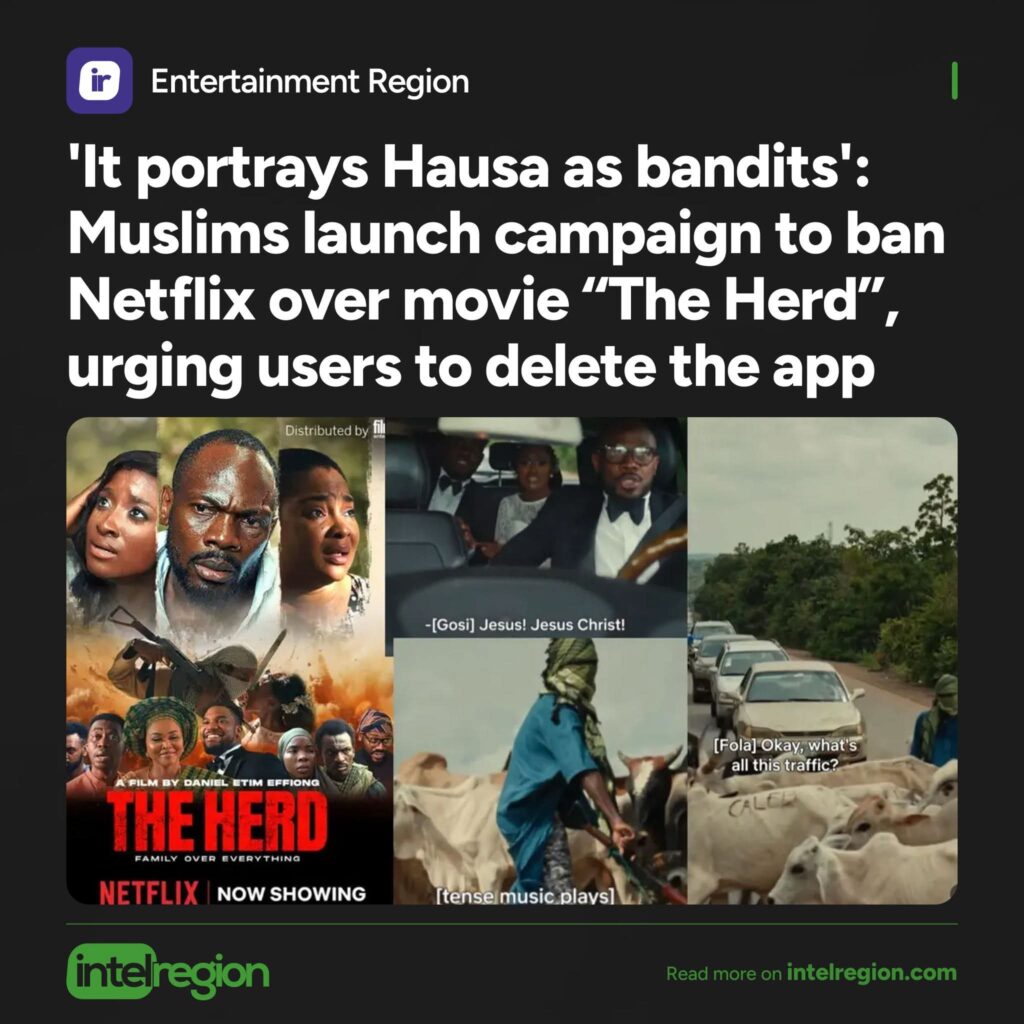
A group of Nigerian Muslims has launched a campaign calling for Netflix to be banned and its services canceled over the streaming of the movie “The Herd.”
The film, which depicts the daily kidnappings of innocent Nigerians by Fulani herdsmen and bandits, has sparked outrage among some viewers. On social media platform X (formerly Twitter), users are urging others to delete the Netflix app from their devices in protest.
The campaign reflects growing tension over media portrayals of sensitive national issues and raises questions about the balance between creative freedom and social responsibility.
Note that Nollywood actor Daniel Etim-Effiong makes his directorial debut with the Netflix movie, “The Herd,” which was released on Friday, November 17th, 2025 and has generated over 30M views.

Sharing the snippet of the movie on Instagram, NaijaonNetflix wrote, “One minute they’re celebrating love, the next they’re fighting for their lives. The Herd is now playing on Netflix.”



The above clips from the Netflix movie, “The Herd” by actor Daniel Etim-Effiong, did not go down well with muslims as they called for the ban of the Netflix app, while some online users shared their contrary opinions, stressing that the movie is the current situation of Nigeria we presently live in.
@Fulani_Tutor said; “Ban Netflix Ban the herd Delete Netflix in your phone As a Muslim you have no business with this movie. Ban Netflix.”
Former President Buhari aide, @BashirAhmaad commented, “The reason why some Arewa people are angry about The Herd movie is not because we are denying the reality of banditry, far from it. It is about the dangerous consequences of profiling an entire ethnic group and region that has already suffered immensely from years of insecurity.
I watched the teaser on @NetflixNaija , and even though I haven’t watched the full movie yet, the one clear problem that stands out is stereotyping. In the teaser, Fulani herders are shown crossing the road with their cattle, while a newlywed couple inside a car and other travellers drive by, then suddenly the herdsmen pull out guns, start shooting indiscriminately and kidnap everyone. This single scene paints a picture that is actually facile as it is dangerously inaccurate.
The truth is this, it is true and verifiable that some of the bandits terrorizing innocent people and our communities are Fulani. We have consistently and openly acknowledged that, called them out, condemned their atrocities and demanded that authorities deal with them mercilessly. Yet the overwhelming majority of Fulani herders are innocent and also among the very victims that have suffered the most from these terrorists.
Many have lost their cattle, their livelihoods and their families. So producing a movie to profile them all as armed kidnappers only reinforces a harmful stereotype that fuels suspicion, resentment and even violence against innocent people. Film and media carry immense influence, they shape global perceptions and frame narratives, especially about communities that are poorly understood outside their regions. Instead of the producers of The Herd helping the world understand the complexity of Nigeria’s insecurity, the movie falls into the trap of blanket judgment.
When such an international movie, portrays a one-dimensional story, millions of viewers around the world walk away believing that every Fulani herder is a terrorist and that is how stigma is created. That is how innocent people become targets of discrimination and harassment. Before producing a film that touches on such a sensitive and complex national issue, the producers should have done intensive field work by engaging stakeholders, security experts, victims, researchers and even representatives of pastoralist groups to help them capture the full picture of the situation.
sirminzy wrote; “I genuinely don’t understand why a certain group is angry that this movie reflects the current realities of Nigeria. Are filmmakers supposed to lie or pretend these issues don’t exist? it’s very clear that the film draws from Nigeria’s past and present security situation. The purpose of storytelling especially in drama is to reflect society. Creators draw ideas from history, present realities, inspirations, dreams, and personal experiences. With that in mind, it becomes clear why The Herd was made the way it is. The film mirrors Nigeria’s current security challenges, which is a valid and long-standing source of artistic inspiration. You can’t accuse a movie of “misrepresentation” when it mirrors events the whole country has witnessed. The movie is not attacking an entire ethnic group. It is addressing a national security crisis. Something that affects all of us regardless of tribe. The movie will nt be cancelled. It dropped at d perfect time and it’s sparking the exact conversations drama is meant to inspire Drama has always been a powerful tool for telling the truth, boldly, honestly, and without fear or favor. If the truth makes some people uncomfortable, maybe that’s the wake-up call we need. Art is supposed to challenge, provoke, and reflect reality, not sanitize it. The Herd is a mirror. If what you see in that mirror bothers you, the solution isn’t to break the mirror. It’s to fix the reality being reflected.”
Food influencer, Opeyemi Famakin uttered; “The best PR Daniel Etim would ever get. Lol, weyrey say Ban Netflix 😂😂😂 you people are funny in this country.”
jbourdy spills, “I cried and cried. Haaa @etimeffiong hmmm. Sadly, this is the Nigeria we live in currently. Well done sir. Beautiful acting. I won’t wish this experience on my enemy though.”



Actress Uche Jombo noted; “The timing of THE HERD Netflix release is perfect for what we are currently experiencing as a country! Watch it please! This situation is just so heartbreaking 💔 How did we get here Nigeria?”
Social media commentator, Daniel Regha tweeted; “The Herd” movie is a poor attempt in trying to represent our reality in Nigeria. While the movie can be praised for its visuals and cinematography, the film pushes negative sterotypes, has a poor storyline, and ending.
1. Negative sterotypes: -The movie portrays the Hausas as bandits, and Yorubas as accomplice, as those were the only languages spoken by the criminals. This gives the impression that certain crimes is based on ethnicity or region. -The movie portrays the Igbos as egoistic, and naive people. Gosi’s parents, and the Igbo abducted victims shows that. -The church was also portrayed as an accomplice to the insecurity issue we face. -And lastly, the police, who abandoned the search for other victims after rescuing just two shows gross incompetence.