






Introduction
When HBO announced a television adaptation of Naughty Dog’s critically acclaimed video game The Last of Us, fans were both excited and apprehensive. Video game adaptations have historically struggled to capture the magic of their source material. However, The Last of Us has defied expectations, becoming one of the most successful video game adaptations in television history with a 96% rating on Rotten Tomatoes and winning Best Adaptation at The Game Awards 2025.
But this raises an important question: Should you play the game or watch the show? And which version tells this post-apocalyptic story better? In this comprehensive comparison, the AllBioHub team breaks down every major difference, similarity, and unique strength of both versions to help you decide which experience is right for you.
Timeline Differences: 2003 vs. 2013
One of the first noticeable differences between the game and show is the timeline. The original game opens in 2013 before jumping twenty years forward to 2033. The HBO series shifts this timeline back a decade, with the outbreak beginning in 2003 and the main story taking place in 2023.
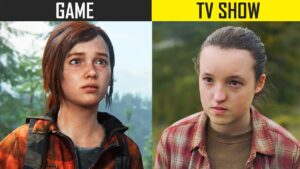

This change serves multiple purposes. First, it makes the story feel more recent and relatable to contemporary audiences. Second, it allows for cultural references and technology from the early 2000s that resonate with viewers who lived through that era. The 2003 setting gives the show a slightly different nostalgic quality, though this timeline shift doesn’t fundamentally alter the core narrative.



Opening Sequences: Scientific Context vs. Immediate Action
The game throws players directly into the chaos of Outbreak Day through Sarah’s perspective, creating an immediate emotional connection through interactive gameplay. You wake up as Joel’s daughter, wander through the house, and experience the outbreak firsthand in a heart-pounding sequence that ends in tragedy.
The HBO series takes a different approach by opening with a 1968 talk show featuring scientists discussing potential global threats. One researcher chillingly predicts that a fungal infection accelerated by global warming could pose the greatest danger to humanity. This prologue provides scientific credibility and foreshadowing that the game delivers more gradually through environmental storytelling and scattered documents.
Both approaches are effective, but they serve different purposes. The game prioritizes immediate emotional engagement, while the show builds atmosphere and context that enriches the viewing experience.
The Cordyceps Infection: Spores vs. Tendrils
Perhaps one of the most significant mechanical differences between the two versions is how the Cordyceps infection spreads. In the game, airborne spores play a crucial role, forcing characters to wear gas masks in contaminated areas. Players must navigate through spore-filled rooms while managing limited resources and dealing with the constant threat of infection.
The HBO series eliminates airborne spores entirely, replacing them with a more visually striking system of fungal tendrils that connect infected hosts. This change was primarily practical—showrunner Craig Mazin explained that having actors wear gas masks would obscure their facial expressions and limit emotional performances. The show also introduces a hive-mind concept where infected are connected through underground mycelium networks, meaning disturbing one infected can alert others miles away.
This change fundamentally alters certain scenes. The memorable moment where Ellie reveals her immunity to Dina happens differently. In the game, Ellie’s gas mask breaks in a spore-filled room, forcing the revelation. In the show, this moment is restructured around different circumstances. Interestingly, Season 2 of the show finally introduces spores in Episode 5, acknowledging this element from the source material while explaining it took two seasons to appear.
Character Development: Interactive Agency vs. Cinematic Storytelling
Joel and Ellie’s Relationship
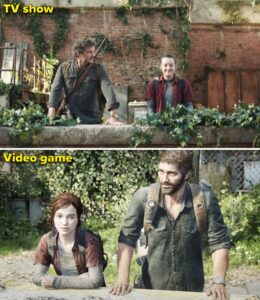
Both versions excel at portraying the evolving relationship between Joel and Ellie, but they achieve this through different methods. In the game, players actively participate in building this bond through optional conversations, shared discoveries, and collaborative combat. You make Joel’s choices, experience his protection of Ellie firsthand, and become complicit in his morally questionable decisions.
Pedro Pascal and Bella Ramsey bring different dimensions to their television counterparts. Pascal’s Joel is slightly more emotionally expressive than Troy Baker’s game version, while Ramsey’s Ellie maintains the character’s resilience and wit while adding their own interpretation. The show has more time to explore quiet character moments without the pressure of maintaining gameplay pacing.
Expanded Supporting Characters
One area where the HBO series particularly shines is in expanding supporting characters who received limited screen time in the game.
Bill and Frank: The game presents Bill as a paranoid survivalist whose partner Frank has already died (apparently by suicide) before Joel arrives. Players learn about their relationship through environmental storytelling and notes.



Episode 3 of the HBO series, titled “Long, Long Time,” completely reimagines their story in what many consider one of the best episodes of television in 2023. The show dedicates an entire hour to Bill and Frank’s love story, from their first meeting to their final day together. When Frank develops an incurable illness, Bill agrees to help him end his life peacefully, and Bill chooses to die alongside him. This expanded narrative adds profound emotional depth and explores themes of love, choice, and companionship in the apocalypse.
Tess: In the game, Tess’s death occurs when FEDRA soldiers storm a building, and she sacrifices herself in a shootout to buy Joel and Ellie time to escape. The show dramatically alters this scene—instead of soldiers, a horde of infected swarms the building after the group disturbs a fungal network. In one of the show’s most disturbing sequences, an infected performs a grotesque “kiss” with Tess through fungal tendrils before she ignites herself and the building.

Marlene: The leader of the Fireflies receives more backstory and screen time in the series, helping viewers understand her motivations and the moral complexity of her decisions regarding Ellie.
Pacing and Action: Constant Combat vs. Selective Violence
The Game’s Interactive Experience
The Last of Us video game is built around resource management, stealth mechanics, and intense combat encounters. Players spend significant time:
– Scavenging for supplies and crafting items
– Sneaking past or engaging with infected and human enemies
– Solving environmental puzzles
– Exploring detailed environments for optional collectibles and story fragments
Read Also: Who Is Bella Ramsey?: From Game of Thrones to Last of Us Full Biography 2026
Who Is Pedro Pascal? Complete Biography 2026 Career Timeline
The gameplay requires frequent violent encounters that some critics argued could desensitize players to violence or create tonal dissonance with the game’s emotional narrative moments. However, others felt this player agency made Joel’s violent actions feel more impactful because players directly participated in them.
The Show’s Narrative Focus
The HBO series dramatically reduces the frequency of action sequences, focusing instead on character development and human drama. When violence does occur, it feels more significant and consequential because it’s less frequent. The infected appear sparingly but memorably—when they show up, these sequences are terrifying and visceral.
This approach allows the show to explore themes and relationships without the obligation of maintaining gameplay engagement. Episodes can vary widely in tone and pacing, from action-heavy sequences to quiet character studies. The show doesn’t need to artificially create combat scenarios to justify its existence as an entertainment product.
Season 2 and The Last of Us Part II: Major Structural Changes
Season 2 of the HBO series adapts The Last of Us Part II, and the differences are even more pronounced than in Season 1.
Joel’s Death: Early and Less Brutal
In the game, Joel’s death is one of the most controversial moments in gaming history. Players control Joel briefly at the beginning before Abby, a new character, brutally kills him with a golf club while a restrained Ellie is forced to watch. This shocking moment defines the entire game.
The show presents this scene in Episode 2 of Season 2, with some notable changes:
– Joel is on patrol with Dina instead of Tommy
– The infected horde breaches Jackson, creating a massive action set piece not in the game
– Abby’s execution is slightly less graphically violent—she stabs Joel in the neck rather than continuing to beat him with the golf club
– Abby’s motivation is revealed much earlier in the show, whereas the game keeps players in the dark about her backstory for many hours
Narrative Structure and Character Perspective
The Last of Us Part II’s controversial structure has players spend the first half as Ellie seeking revenge, then forces them to play as Abby for the second half, gradually revealing her perspective and making players empathize with the person who killed Joel. This works brilliantly in a game because of player agency—you literally kill Abby’s friends as Ellie, then experience the consequences of those actions as Abby.
The show cannot replicate this interactive empathy exercise. Season 2 takes more narrative freedom, introducing Abby earlier, revealing her motivations upfront, and restructuring the timeline. Some fans appreciate these changes as necessary adaptations for television, while others feel they lose some of the game’s emotional impact.
Condensed Timeline and Pacing Issues
Season 2 only has seven episodes to cover a game that takes approximately 24 hours to complete. This compression has led to some criticism:
– Ellie’s Seattle arc feels rushed compared to the 11+ hours of gameplay it represents
– Some character development moments are abbreviated or omitted
– The show ends at the season’s midpoint of the game’s story, with Season 3 confirmed to continue the narrative
However, this condensed approach also eliminates some of the gameplay padding and maintains tighter narrative focus.
Visual Presentation: CGI vs. Live Action
The Game’s Artistic Achievement
The Last of Us (especially in its 2022 remake The Last of Us Part I) features stunning graphics that pushed PlayStation hardware to its limits. The environmental design is extraordinarily detailed, with every location telling stories through visual elements. The facial animation and motion capture performances were groundbreaking for 2013.
However, the characters are still CGI creations. While incredibly realistic, they exist in the uncanny valley for some viewers, particularly older audiences less accustomed to video game graphics.
The Show’s Practical Effects and Production Design
The HBO series brings this world to life with practical locations, sets, and effects that feel tangibly real. The production design meticulously recreates iconic game locations while adding new layers of detail. The infected are brought to life through a combination of prosthetics and CGI, with the practical effects on Clickers being particularly praised for their horrifying authenticity.
Filming took place across various Canadian locations that convincingly portray the diverse American settings. The attention to detail in recreating the game’s aesthetic while making it feel like a lived-in world is remarkable.
Accessibility and Audience Reach
The Game’s Limited Accessibility
Video games require:
– Gaming hardware (PlayStation consoles or PC)
– Time investment (15-30 hours for completion)
– Gaming skills and familiarity with controller mechanics
– Active engagement and participation
According to research, approximately 24% of Americans under 18 and 33% of adults over 18 don’t play video games. This means The Last of Us as a gaming exclusive had limited reach among certain demographics, particularly older audiences.
The Show’s Broader Appeal
Television is a passive medium that requires no special skills or equipment beyond a subscription to HBO/Max. The show has introduced The Last of Us to millions who would never have experienced the story otherwise. Its mainstream success has made it a cultural phenomenon beyond gaming circles.
The show’s approach to diversity and casting (including Pedro Pascal’s portrayal of Joel and expanded LGBTQ+ representation) has also broadened its appeal.
Thematic Depth: Player Complicity vs. Observed Morality
The Game’s Interactive Morality
One of The Last of Us game’s most powerful aspects is how it makes players complicit in Joel’s morally questionable actions. You pull the trigger, you make the violent choices, and you carry out the devastating finale. The game doesn’t give you a choice in key moments, forcing you to proceed even if you disagree with Joel’s decisions. This creates a unique relationship with the character and the narrative.
The game also explores its themes through optional content—conversations you can initiate, notes you can read, and environmental details you can discover at your own pace.
The Show’s Observed Morality
As a television viewer, you maintain emotional distance from the characters’ actions. You can judge Joel’s choices without being responsible for them. This allows for a different kind of moral contemplation—you’re a witness rather than a participant.
The show must make all its thematic content explicit rather than optional, leading to more directed storytelling but potentially less player-driven discovery.
World-Building: Environmental Storytelling vs. Explicit Expansion
The Game’s Discoverable Lore
The video game excels at environmental storytelling. Players who explore thoroughly are rewarded with:
– Notes and letters revealing personal stories
– Environmental details showing what happened in locations
– Optional conversations that deepen character relationships
– Collectibles that build the world’s history
This approach respects player agency and rewards curiosity, but also means some players miss significant story elements.
The Show’s Expanded Universe
The television series can explore the world beyond Joel and Ellie’s immediate perspective. Cold opens and side episodes like the Jakarta sequence in Episode 2 or the complete episode dedicated to Bill and Frank provide context and world-building that would be difficult to implement in a game without breaking gameplay flow.
The show also depicts the social structures, politics, and daily life in quarantine zones more thoroughly than the game, giving viewers a fuller picture of how society functions in this world.
Awards and Critical Reception
The Game’s Accolades
The Last of Us (2013) won:
– Over 200 Game of the Year awards
– BAFTA Games Awards for Best Game, Best Story, Best Action and Adventure Game
– Multiple D.I.C.E. Awards including Game of the Year
– The Game Awards for Game of the Year (retroactively, as the awards started in 2014)
It’s consistently ranked among the greatest video games ever made.
The Show’s Recognition
The HBO series has earned:
– 96% on Rotten Tomatoes
– Emmy nominations for Outstanding Drama Series
– Best Adaptation at The Game Awards 2025
– Second-highest performing new series premiere for HBO in a decade
– Critical acclaim for performances, particularly Pedro Pascal and Bella Ramsey
Both versions have achieved extraordinary success within their respective mediums.
Which Should You Experience? AllBioHub’s Recommendation
After analyzing both versions comprehensively, here’s the AllBioHub team’s recommendation:
Recommendation: Experience Both, Starting with the Show
For First-Time Audiences:
We recommend starting with the HBO series if you:
– Don’t regularly play video games or find gaming mechanics challenging
– Want a time-efficient way to experience the story (9 episodes vs. 15+ hours)
– Prefer passive entertainment over interactive experiences
– Are drawn to the show’s expanded character development
– Want to experience the story with others (watching is more social than gaming)
Then Play the Game Because:
– You’ll appreciate the gameplay mechanics and interactive elements with story knowledge
– The game offers additional depth, optional content, and extended sequences
– You’ll enjoy spotting the differences and seeing alternate takes on scenes
– The interactive nature will give you a fresh perspective on Joel’s choices
– You’ll experience memorable gameplay moments that don’t translate to television
For Gamers:
If you’re already a gamer, play the game first:
– Experience the story as it was originally conceived
– Avoid spoilers and preserve major plot surprises
– Fully appreciate the show’s adaptations and changes
– Enjoy the interactive agency that makes the story uniquely powerful
– Then watch the show to see a new interpretation and expanded elements
Why Both Are Essential:
The Last of Us works exceptionally well in both formats because each medium brings unique strengths:
The Game Excels At:
– Player agency and interactive storytelling
– Resource management creating constant tension
– Environmental storytelling and optional depth
– Making players complicit in moral decisions
– Extended character development through gameplay hours
The Show Excels At:
– Cinematic presentation and production value
– Expanded supporting character storylines
– Accessibility to broader audiences
– Selective violence that carries more weight
– World-building beyond the protagonists’ perspective
The Verdict:
Neither version is objectively “better”—they’re complementary experiences that each enhance appreciation for the other. The show is not merely a translation of the game; it’s a legitimate reimagining that stands on its own merits while respecting the source material.
For the ultimate The Last of Us experience, the AllBioHub team recommends:
1. Watch the HBO series to understand the core story and characters
2. Play The Last of Us Part I (the 2022 remake) to experience the interactive version
3. Watch Season 2 of the show
4. Play The Last of Us Part II to see how the game handles the controversial story
5. Follow Season 3 when it releases to see the show’s conclusion
This approach allows you to appreciate both versions fully, understand the creative decisions behind each adaptation choice, and engage with The Last of Us as a multimedia franchise rather than choosing one over the other.
Frequently Asked Questions
1. Do I need to play the game before watching the show?
No, the HBO series is designed to be accessible to newcomers. It tells a complete story that requires no prior knowledge of the game. However, game fans will appreciate numerous references and callbacks.
2. Is the show faithful to the game?
Season 1 is remarkably faithful to the game’s core narrative while making meaningful changes to enhance the television format. Season 2 takes more creative liberties with structure and pacing, but maintains the essential themes and story beats of The Last of Us Part II.
3. Are there major plot differences between the game and show?
Most major plot points remain the same, but the execution differs. The biggest changes include Bill and Frank’s expanded story, Tess’s altered death scene, Joel’s death being slightly less graphic in Season 2, and Abby’s earlier introduction in the show. The core journey and ending remain consistent.
4. Which version has better graphics/visuals?
This depends on preference. The game (especially the 2022 remake) has stunning CGI graphics and art direction. The show has practical effects, real locations, and live actors. Both are visually impressive in different ways. The show’s practical infected effects are particularly noteworthy.
5. How long does it take to play the game vs. watch the show?
The Last of Us game takes approximately 15-20 hours to complete for the main story, with completionist playthroughs extending to 25-30 hours. The HBO show’s first season is nine episodes (about 9 hours total), and Season 2 is seven episodes (about 7 hours). The show is significantly more time-efficient.
6. Is the show appropriate for younger audiences if they played the game?
Both the game and show are rated M/MA for mature audiences due to intense violence, strong language, and mature themes. The show may feel more intense to some viewers because of its realistic presentation, while the game’s interactivity can make violence feel more impactful in different ways. Neither is appropriate for children.
7. Will there be a Season 3 of the show?
Yes, HBO has renewed The Last of Us for Season 3, which will continue adapting The Last of Us Part II. The game’s story will be split across Seasons 2 and 3, with Season 2 covering approximately the first half of the game’s narrative.
8. Does the show include the Left Behind DLC?
Yes, Season 1 includes elements from the Left Behind DLC that explores Ellie’s backstory with her friend Riley. The show integrates this content differently than the game, but the core story remains.
9. Are Pedro Pascal and Bella Ramsey good as Joel and Ellie?
Both actors have received widespread critical acclaim for their performances. While they bring different interpretations than the game’s voice actors (Troy Baker and Ashley Johnson), they capture the essence of the characters while adding their own nuances. Most fans and critics agree they are excellent in the roles.
10. Can I play the game on multiple platforms?
The Last of Us was originally a PlayStation exclusive. The 2022 remake, The Last of Us Part I, is available on PlayStation 5 and PC. The original game and its remaster are available on PlayStation 3 and PlayStation 4. The sequel, The Last of Us Part II, is currently only available on PlayStation 4 and PlayStation 5.
Conclusion
The Last of Us represents a landmark achievement in video game storytelling that has successfully transitioned to television without losing its soul. Both versions offer profound, emotionally devastating experiences that explore themes of love, loss, survival, and the moral complexities of protection and revenge.
The game provides an interactive journey where your participation makes Joel’s choices feel personal and consequential. The show offers a cinematic experience with expanded world-building and accessibility that has brought this story to millions of new fans.
Rather than asking which is better, the AllBioHub team encourages you to think of them as two different windows into the same powerful narrative. Watch the show for its stellar performances, production value, and expanded character moments. Play the game for its interactive storytelling, player agency, and the unique way it makes you complicit in its moral dilemmas.
The Last of Us proves that with the right creative team, respect for source material, and willingness to make medium-appropriate changes, video game adaptations can be not just successful, but essential cultural works that stand alongside their source material as equals.
Whether you’re a longtime fan or discovering this world for the first time, The Last of Us in all its forms remains one of the most compelling stories in any medium—a testament to the power of storytelling itself, regardless of how it’s delivered.
AllBioHub Rating:
– The Last of Us Game: 9.5/10
– The Last of Us HBO Series: 9/10
– Recommendation: Experience both for the complete story